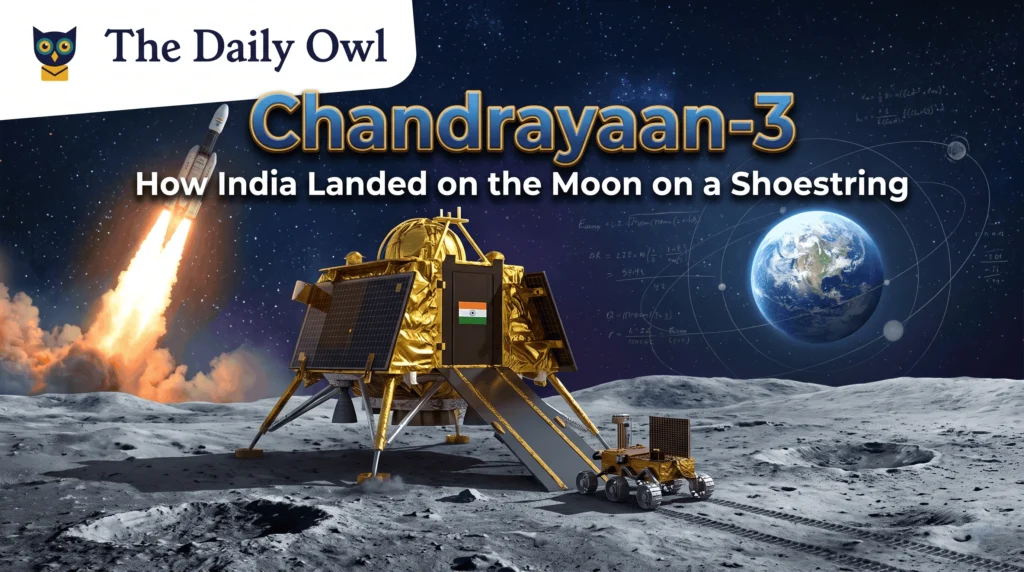
On 23 August 2023, at about 6:04 pm IST, a lander named Vikram touched down near the Moon’s south pole. India became the fourth country to soft-land on the Moon, after the Soviet Union, the United States and China, and the first to do it so close to the south pole.
The failure that made it possible
Four years earlier, Chandrayaan-2’s lander had crashed during its final descent. Instead of hiding the setback, ISRO studied it in public detail. For Chandrayaan-3 the team widened the landing area, added more fuel margin and built in extra redundancy. The lesson was simple: design for the things that can go wrong, not only for the things that should go right.
Why the south pole?
Some craters near the lunar poles have not seen sunlight for billions of years. Scientists believe they may hold water ice, which could one day supply drinking water, oxygen and rocket fuel for future missions. That makes the region one of the most interesting places to explore.
What Pragyan found
The six-wheeled rover Pragyan rolled out of the lander and drove roughly a hundred metres. Its instruments recorded the temperature of the lunar soil at different depths and detected sulphur near the surface. The mission was planned for a single lunar day, about 14 Earth days, and the lander and rover went to sleep as the long lunar night began.
Doing more with less
The mission’s cost was widely reported at around ₹600 crore, less than the budget of several Hollywood space films. It was not a one-off. In 2014 India’s Mangalyaan became the first mission to reach Mars orbit on its maiden attempt, and the first by an Asian nation.
In space, frugality is not about cutting corners. It is about solving the problem with fewer moving parts.
India now marks 23 August as National Space Day. For the next generation of students, the Moon is no longer someone else’s destination.