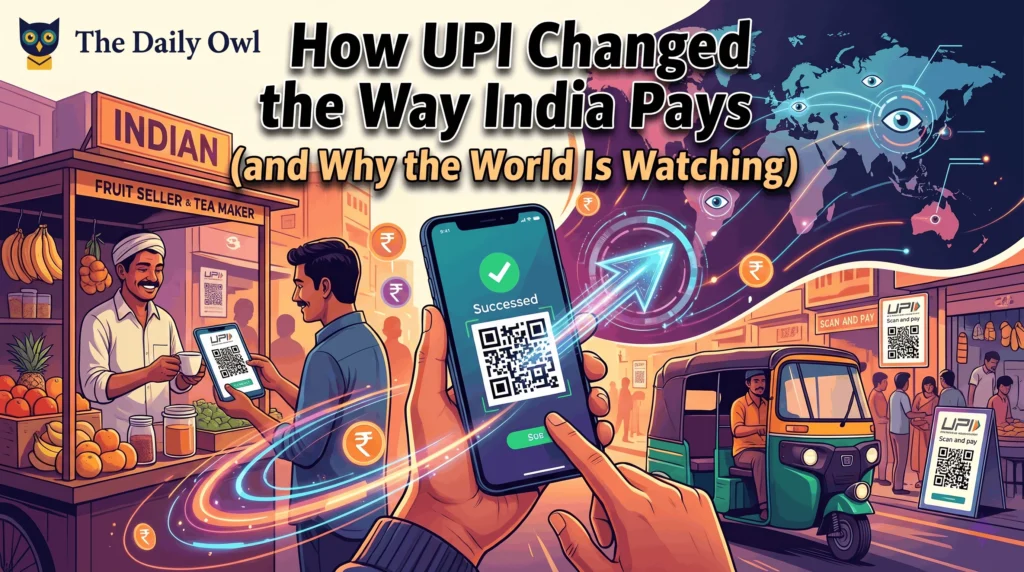
Not long ago, paying a street vendor meant counting coins. Today you scan a printed QR code, type a PIN and the money moves in seconds. That small moment is the result of one of the most ambitious public digital systems in the world: UPI.
What UPI actually is
Unified Payments Interface was launched by the National Payments Corporation of India (NPCI) in April 2016. It is not an app. It is a shared network that lets any bank account talk to any other, through any app, using a simple address like name@bank. You do not need to know the other person’s account number or IFSC code.
Why it spread so fast
- It is interoperable. You can use any supported app and still pay anyone.
- It works 24×7. Transfers settle instantly, including on holidays.
- It is cheap for small merchants. A paper QR code costs almost nothing, so chai stalls and flower sellers can accept digital payments.
- It rides on basics. Cheap smartphones, mobile data and bank accounts opened under the Jan Dhan drive gave it a huge base.
The scale
Monthly UPI transactions crossed 10 billion in 2023, and the volume has kept climbing since.
Going global
UPI is now linked with systems in countries such as Singapore, and merchants in places like France and the UAE accept it. Other countries have studied the model for their own instant payment systems.
Staying safe
Fast payments attract fraudsters. A few habits help:
- You never need to enter your PIN to receive money.
- Be wary of “collect request” messages from strangers.
- Never share your PIN or OTP, even with someone claiming to be from your bank.
Figures change quickly, so check NPCI’s website for the latest numbers. What is certain is that India’s biggest tech export may be an idea: build the rails once, and let everyone ride.